Friday, May 10, 2019

Two Warbling Migrants That Won't Keep Quiet!


Two of the more common spring migrants in our are the Yellow Warbler (above) and the Warbling Vireo (below).Yellow Warblers operate mostly near ground level. I saw 4 males in one location this weekend chasing each other around and trying to out-sing each other in an effort to see who claims rights to which real estate.

 They are frequent victims of Brown-headed Cowbirds who lay their eggs in the Yellow-Warblers nests in order to pass off the parenting responsibilities to the poor Yellow-Warbler. However, the warblers have figured out a way to outsmart the cowbirds by building another nest over the top of the cowbirds eggs!
Most new birders are haunted by the sound of the singing Warbling Vireo. They have a song that repeats the same pattern over and over all summer long but they aren't always the easiest birds to see. When you do find one it can be a little disappointing to find out that the source of all this singing is just a plain, drab grayish bird!

Monday, May 6, 2019

Red White & Blue

I saw this cardinal 10 years ago. I was standing silently in the middle of a mess of small trees. It landed so close to my face that I had to lean back to take a picture and I still couldn't get the whole bird!
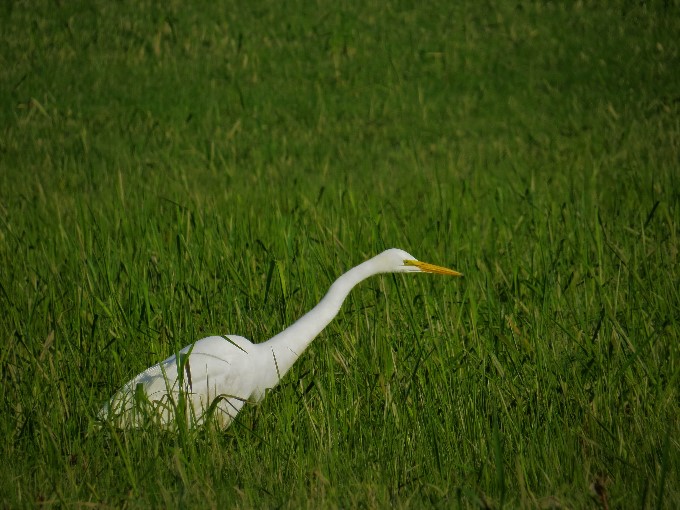
I recently saw this great Egret at our local fairgrounds. I enjoy seeing these birds away from the shoreline where most of them seem to be.
I saw this Indigo Bunting at Machimoodus Park. They appear kind of black when the light isn't reflecting off their feathers. The park is already chock full of birds but someone likes to throw seed down to attract them to certain areas.

Sunday, May 5, 2019

Falling Rain And Falling Birds

 Every year there comes a time in May when birds are literally dripping from the trees.This weekend brought rain and with it came a storm of migrant birds.
 The warbler action really started picking up as many new species have arrived including the Prairie Warbler that has an ascending song that reminds me of a glass being filled by pitcher of water.
 I didn't have the time to count all of the Great Blue herons at their nest sights so I stopped at 75.
 Even though it was cloudy with a light rain, it still turned out to be an incredible morning of birding, seeing about 50 species  including a handful of  Wood Ducks hiding in trees.

It gets a little crazy during the month of May. While you're trying to track down the movements of one bird you notice several more in your peripheral vision moving around in the trees. It can be a  tiring but it's a nice problem to have!

Sunday, April 28, 2019

Hidden Birds In A Hidden Frontier

 In the southeastern corner of Middletown Connecticut lies an area of land called Maromas. A long time ago it was a fishing/farming village. Today with the exception of Pratt and Whitney, it is sparsely inhabited. It is sometimes referred to as Middletown's last frontier. There are plenty of streams, forest, marsh , and reservoirs in the area making it a good birding destination. 

I heard my first of year  Louisiana Waterthrush singing at this stream but never got a look at him.
 It was a cloudy day and although there were dozens of Yellow-rumped Warblers only 1 landed near me when I had the camera handy.
Within the hidden village of Maromas there are also hidden birds. If you look closely you can see a little tail sticking out of what looks like a clump of tree bark but is actually a nest.
The tail belongs to this bird, the tiny Blue-gray Gnatcatcher.
 As you walk up an old stretch of railroad tracks you are surrounded by marshland on both sides. I scared up many Wood Ducks along the away and saw some Great Blue Herons but not much else was visible.

Even the Mute Swans were hiding which doesn't happen too often.

I love areas that are overlooked and underbirded. Maromas is one of those special places and I plan to return there several times this year.