Thursday, June 21, 2012

Customized Notebooks For Sloppy Birders?

I like to keep a record of what I see while I'm out birdwatching but I've never been satisfied with the notebooks or checklists I've used. I finally decided that my best option would be to design my own field notebook instead of buying one online or at a store.
I started out using simple checklists like this one, that recently I found stuffed under my truck seat. Checklists are convenient because the names of the birds are already printed out. All you have to do is record the species you see in check box. I have a few issues with using these checklists.  I have a few issues with using checklists like this one: 
  1. There are hundreds of species printed on this list but I only see an average of about 40 per outing.
  2. The print is very small and there isn't much room to make extra notes or sketches.
  3. They end up under my truck seat with coffee stains on them instead of being neatly filed away.
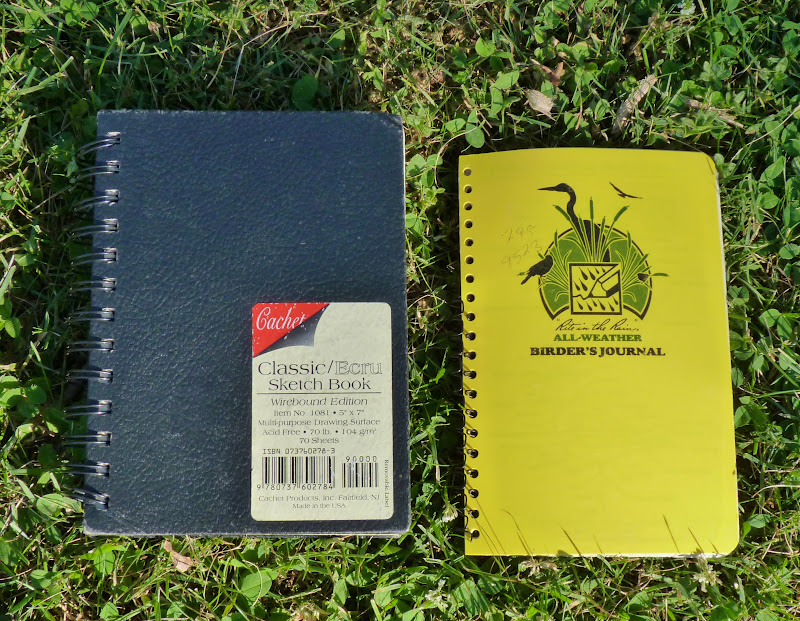
I've used notebooks like these to take notes as well. They allow me the freedom to take notes or make sketches but I also have to write in every species I see by hand. That is a tedious chore and my penmanship is not exactly stellar. I was born left handed but for some mysterious reason an elementary school teacher decided I should write with my right hand.
It finally occurred to me that I might be able to design my own customized field  notebook. The first step was to put together a checklist of birds that I see most often and then put them on to an excel spreadsheet (with some help from my cousin-thanks Bob). It was difficult for me to decide which species to leave off the list and how to organize them. The order I used was a mix of  alphabetical, taxonomic, and whatever I felt would work for me. The final step was went to have the notebooks printed up at a print shop. I opted for using spiral binding and a heavier grade of paper. There are cheaper ways of going about this project, like using a 3 ring binder, but cutting costs was not my primary objective.
Each checklist takes up the front and back of a single page. The back of each page also has room for additional species that weren't included on my checklist. On my first outing with this new notebook I had to write in Orchard Oriole. I don't mind writing a few species in by hand, especially birds that I don't see often.
 I decided not to alternate blank pages between the checklists. Instead, I included a separate section in the back in case I decide to make additional notes or drawings which can be referenced back to a particular checklist. The notebook is not perfect but it's better than anything I've used before. The nice part about it is that further adjustments can be made in the future if needed. 

  My final cost was $12 per notebook. A little pricey, but in the end it was well worth it to me. Most birders are probably fine with the system they use now but if you are a disorganized birder like me, a customized notebook might be an option to consider. 

Wednesday, June 13, 2012

Trying To Find Birds In Forests Filled With Trees

According to Wikepedia there are over 30 state forests in Connecticut. I'm intrigued by what species of birds might exists within these state forests. A forest is defined as a dense growth of trees, plants, and underbrush covering a large area. It's not easy to see birds in a dense growth of trees. I played the waiting game with this Blue-gray Gnatcatcher. I heard it making it's squeaky noises for quite a while before it finally came near the edge of the state forest road where I could see it.
I found these Rough-winged Swallows nesting in a drain pipe in a reservoir near a state forest. There were no trees obstructing my view here.
Many forests have bodies of water such as lakes or reservoirs within their boundaries. I spotted this Osprey flying over the Portland Reservoir.
 It's sometimes easier to find birds near streams especially on a hot summer day. I found a lot of Louisianna Waterthrushes near streams this Spring. 
I appreciate birds like this Palm Warbler. If they're around they're usually not hard to find, not even in a forest.
When I'm in a forest, I spend most of my time on the main roads. You can cover more ground that way and it give you a better viewing area. Birding by horse and buggy might not be a bad way to go.
There are often power lines running though or near state forests. Those are great places to find Prairie Warblers and Blue-winged Warblers like this one.
. The trees in this particular section of Cockaponset Forest were tall and and not as dense as other areas in the forest. I believe some selective cutting must have been done here. It also had some smaller shrubs and vegetation. It turned out to be a productive spot where I found nesting Hooded Warblers , Chestnut-sided Warblers, Rose-breasted Grosbeak, Black & White Warbler, and Pileated Woodpecker.

  There are a ton of birds in some of these forests because I can hear them but it's a lot more fun when you can actually see them. Searching  areas near water, forest roads and areas where trees have been selectively cut seems to be the key. I'm guessing its going to take a few years before I've visited all 32 of the state's forests.
click to play
 Eastern Towhee performing the drink-your-tea song.

Thursday, May 31, 2012

Across The 45th Parallel Into North Country

Over the past 30 years or so it has been a tradition for my father and I to take a spring fishing trip somewhere up north. One of our favorite place to visit is Pittsburg, New Hampshire located next to the Canadian border. I love the natural scenery up there. There are lakes, streams, and mountains every where you turn. I felt like a kid again as I ran across a field of dandelions to take a few casts into an alluring trout stream.
This year we stayed at a place called The Glen on First Connecticut Lake. You stay in your own cabin which overlooks the lake and home cooked meals are included in the cost. When you hear the old bell ring you know it's time for breakfast or dinner. That's part of what I love about it up there. It almost like traveling back in time.
Here's a photo of one of the sitting rooms in the main lodge. The The owner of the Glen is a spry, 87 year old lady named Betty who has been running the Glen for the past 51 years. She still keeps a sharp eye on her staff and has lots of interesting stories to tell.
Unless you have down-riggers or use lead line it can be tough to catch fish in the bigger lakes so we took a ride over to a smaller pond to try our luck.
Other than a Lake Trout, this is one of the biggest trout I've caught. I released it without weighing it but I'd estimate it to be at least 3 1/2 lbs .
 At night the mournful sound of loons from across the lake echoed across the water carrying with them memories from years passed. Hearing a familiar song sometimes triggers a memory from the past that is connected to that particular song. For me, loons are the song of the north.
This loon was nesting near a trail along a river.
Naturally, I managed to take a break from fishing to spend some time birding. Pittsburg is on the southern edge of the boreal zone so there is potential to see some birds that I can't find in Connecticut. The woods were alive with the sound of warblers singing including Northern Parula,  Black-throated Blue, Blackburnian, Black-throated Green, and Bay-breasted Warbler. There were a couple whose songs I didn't recognize and was frustrated not to be able to locate the birds. I came across a flock of Pine Grosbeaks and some crossbills as well.
It was difficult to get bird photos because the skies were cloudy most of the time but I attempted to get a photo of this Gray Jay. I also spooked up several grouse. I think at least one of them was a Spruce Grouse but they didn't give me much time to identify them before scooting off into the thick woods.
There is an ice cream shop along route 3 called Moose Alley Cones. The owner has about 20 pair of Cliff Swallows nesting under the eaves of her house!

Pittsburg is not a place that would appeal to everyone. Other than  it's natural beauty and old-fashioned charm there isn't a whole lot going on there but I always look forward to going back.

Wednesday, May 16, 2012

5 Symptoms Of Avian Snob Syndrome

                                          Are  Chipping Sparrows a dime a dozen?

When you first start birding just about every bird you see seems like a good one. Then you start to familiarize yourself with all the species in your area and things change. You begin to grow tired of seeing common, everyday birds and start to search for migrants, rare birds or any species you haven't seen.

 If you feel as though looking at common birds though your binoculars is a waste of time then you might be  suffering from Avian Snob Syndrome :
 
Here are 5 signs that you may be suffering from this affliction:

1) "I could have seen one of those in my own backyard."
Have you ever been an organized birding field trip and thought to yourself-something along the lines of-"Let's get to the good stuff- I can see one of those birds in my own backyard"  I've actually heard other birders say things like that during field trips on several occasions.

2) Have you seen anything good this morning?
Have you ever been out at a popular birding spot and asked another birder- "Have you seen anything good this morning."

What if their response was-"Yes, I saw a beautiful Cardinal and 2 nice Blue Jays, and a Mourning Dove."

I'm assuming that you would have a polite response but honestly, what would you really be thinking to yourself?

I've often heard experienced birders say "the usual suspects" in response to the same question which is another way of saying same old stuff. What is the crime a that these birds are suspected of committing?

3) The second you identify one common species you're already looking for the next.
See the bird-identify the bird and on to the next one. Most birds just aren't worthy of a second look-right?

4) You say that you like to study bird behavior-but for how long?
You study bird behavior-really? Lots of birders claim this but for how long -20 seconds? I doubt many birders spend a lot of time studying the behavior of common birds. 

5) You subconsciously rate the species you see:
What would you rather see-A House Sparrow or a Cedar Waxwing? A Yellow-rumped Warbler or a Blackburnian Warbler? Chances are, you have an answer to those questions because many birders tend to place a value on each species they encounter. This might be based on rarity, appearance, or other factors but ask yourself this question. Is one species really better than another?

I wish that I could say that I'd be just as excited to see a catbird today as I was the first time I saw one. The truth is that I too have suffered from symptoms of Avian Snob Syndrome. If we dismiss 95% of the birds we see as being too common to be worth our attention then 95% of our time spent birding is also a waste of time. The good news is that we have a choice. With a little patience, creativity, and imagination we can continue to enjoy watching birds even if they're not listed on the daily rare bird report. I think it's worth the effort.